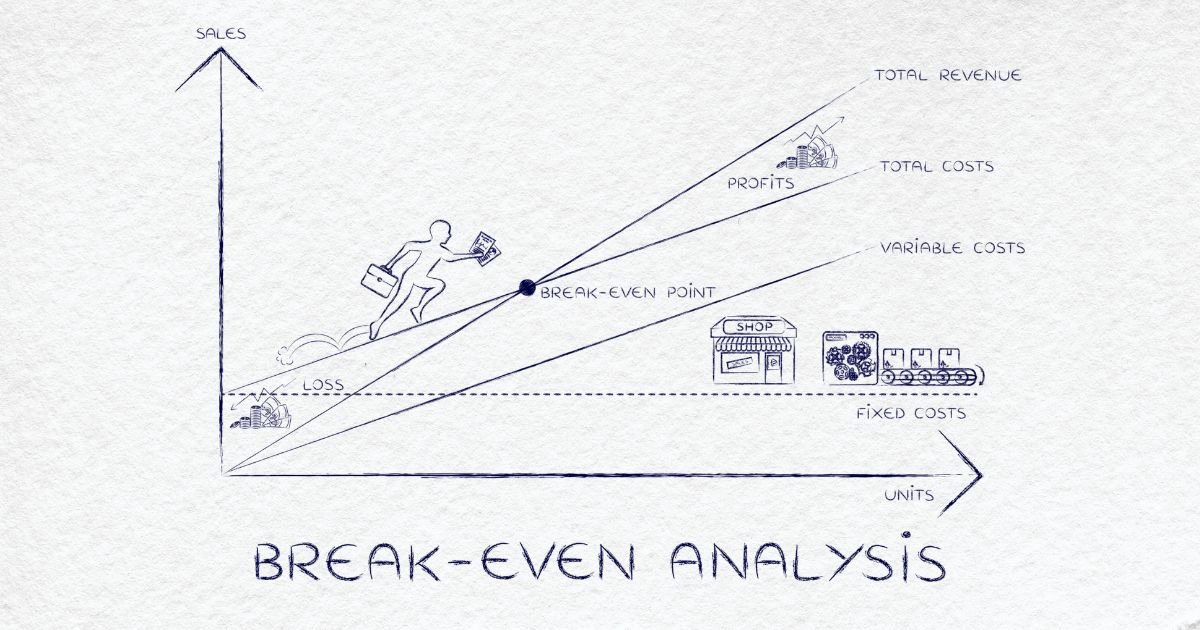
Running a business is exciting when you think of all that can be accomplished. From launching a new product or expanding your current offerings, the excitement is palpable. The one uncertainty that comes with running a business is financial. This is where your break-even analysis comes in.
Understanding where your business is financially will provide you with insights into what must be done to reach profitability. Having a comprehensive break-even analysis will help you set sales prices, make cost adjustments and gauge cash flow needs.
For small to medium-sized enterprises (SMEs), a break-even analysis is critical when it comes to identifying your funding needs.
In this article, we look at what a break-even analysis is, how it works and outline the formula used to calculate it.
What is a Break-Even Analysis?
A break-even analysis compares income from sales to the fixed costs of doing business. The five components of a break-even analysis are fixed costs, variable costs, revenue, contribution margin, and the break-even point (BEP).
When companies calculate the BEP, they identify the amount of sales required to cover all fixed costs before they can generate a profit. The BEP formula indicates the break-even point in units sold or total sales dollars.
Benefits of a Break-Even Analysis
A good break-even analysis gives businesses a foundation for financial planning. The result informs budgeting by setting spending limits based on expected sales. Other ways in which businesses benefit from a break-even analysis include:
- Set prices: The calculation shows whether a price can cover both fixed and variable costs. Businesses use the result to review prices and profit margins.
- Set sales goals: The break-even point gives teams a revenue or unit target. Teams can use it to establish monthly or quarterly goals.
- Assess financial risk: The analysis reveals whether expected demand is high enough to cover costs.
- Plan for funding: In some cases, the break-even analysis appears in business plans and funding applications. A break-even analysis gives lenders and investors a view of the company’s path to profitability.
When to Use a Break-Even Analysis
The following are the most common scenarios where a break-even analysis can help.
1. Starting a New Business
The break-even analysis can estimate how much a new business needs to sell to cover its costs. The result can be used to review pricing and startup expenses before launching.
2. Creating a New Product
A new product may add costs for materials, production, or fulfilment. Before launching a new product, a break-even analysis calculates how many units need to sell at a set price to recover those expenses.
3. Adding a New Sales Channel
Each sales channel introduces its own costs and fees, which affect the break-even point. For example, a pop-up shop may require rent, staffing, and equipment. This also applies to adding new online sales channels like Shopify. Those costs need to be part of the break-even analysis.
4. Changing the Business Model
A change in business model can affect both fixed and variable costs. Moving from dropshipping to holding inventory, for example, adds purchasing and storage costs that may require a different price or sales target. Perform a cost-benefit analysis to compare the added expenses with the expected financial return before making the change.
Limitations in Break-Even Analysis
Break-even analysis treats costs and the price per unit as constant. It also uses sales volume as the only factor changing costs and revenue. Changes in demand, pricing, or operating costs can make the result less accurate.
Limitations to keep in mind include:
Not a Predictor of Demand
The calculation shows how much a business needs to sell. It does not show how many people will buy the product.
Dependent on Reliable Data
The results of a break-even analysis are reliant on accurate figures. Costs that change over time or fall into more than one category can make the calculation less precise.
Simplistic
Businesses often sell several products at different prices. A separate calculation may be needed for each product, or the business may need to use an average selling price. This model assumes that only one thing changes at a time. In reality, as prices fluctuate, so do costs.
Ignores Time
The break-even analysis is a snapshot, completely ignoring fluctuations over time. Your time frame will be dependent on the period you use to calculate fixed costs.
It doesn’t account for future changes. If raw material costs double next year, the break-even point will be a lot higher unless you raise your prices.
Ignores Competition
The break-even analysis does not account for competitor pricing or other market conditions that influence demand. If a competitor lowers its prices, your business may need to adjust pricing or sales targets.
Break-even analysis provides a starting point for reviewing costs and sales targets. Sales forecasts and cash flow reports can add more detail when planning business changes.
Break-Even Analysis Formula
You can calculate the break-even point in two different ways, by volume (units sold) or by revenue. Both formulas rely on contribution margin. Contribution margin is the amount left from each sale after variable costs are removed.
Break-even point in units:
Break-even point (units) = Fixed costs / Contribution margin per unit
Where contribution margin per unit = Average selling price – Variable cost per unit
Break-even point in sales Rands:
Break-even point (sales Rands) = Fixed Costs / Contribution margin ratio
Where contribution margin ratio = Contribution margin per unit / Average selling price
The above is the formula you can use to calculate your break-even point.
You can also download the break-even analysis template.
Benefits of a Break-Even Analysis
The break-even analysis is a key part of the cost-volume-profit (CVP) analysis. The CVP analysis evaluates how hypothetical changes in activity levels could influence revenue and costs. The break-even analysis also supports:
- Decision-making: When considering a new product launch, investment or process change, understanding the impact on the break-even point can help determine whether these actions are practical or achievable in the context of production capacity and market demand.
- Revenue targeting: The BEP and CM help a company establish targets for revenue, pricing, and sales, so that goals are set at levels that drive profitability.
- Cost management: Categorising costs into fixed and variable elements offers valuable insights into the company’s cost structure, including identifying opportunities to reduce or optimise expenses. Additionally, this process helps managers set cost targets by working backwards from desired profitability and a realistic BEP.
- Risk management: Modelling potential situations using a break-even analysis helps companies see potential results of various scenarios before investing resources.