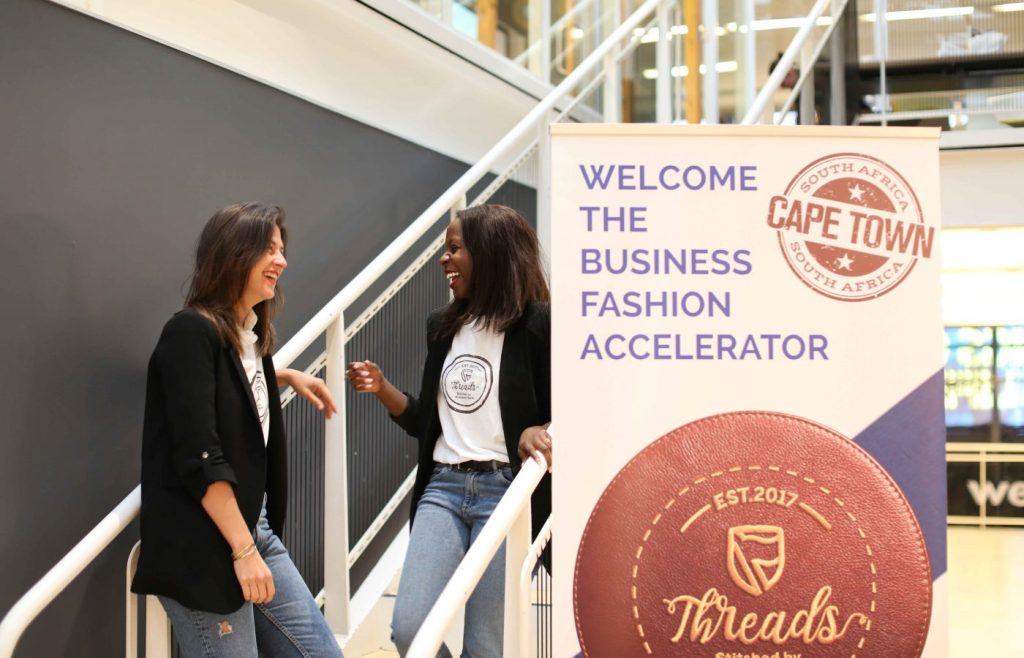
Threads is a a Johannesburg-based fashion accelerator founded in 2016 by Rwandan Tania Habimana and Desiree Brouwer. The two entrepreneurs combined their expertise in digital marketing, media and strategic business development to give birth to an integrated marketing company with focus on creating impact programs and enterprise development campaigns in Africa. Simply put, we help entrepreneurs & SME’s in Africa grow.
Habimana reflects on the programme’s first year.
A year ago today marked the start of our very first Business Of Fashion Accelerator program, Threads Stitched by Standard Bank www.wearethreads.com
We, the founders of NONZēRO Africa, started this because we truly got frustrated at a hard reality. The one that the global fashion market is worth 3 trillion USD and Africa accounts for less than 1% of that, we wanted to see this change! We wanted to see the outstanding talent we come across every day in Johannesburg, Durban, Nairobi, Lagos and more, turn into revenue for our economies and jobs for our citizens.
We didn’t want “teachers” that had never done what they would be teaching
Turning designers into CEOs
So we created an 18-week program, designed to teach fashion entrepreneurs about the business side of fashion – from omni-channel distribution to eCommerce to IP protection and human resource management.
The program was curated by the University Catholic of Milan and E4Impact, their impact entrepreneurship MBA foundation arm, and was deployed in 4 regional hubs, Johannesburg, Cape Town, Port Elisabeth and Durban simultaneously, with each hub welcoming 3 entrepreneurs.
We knew we’d need support? And Standard Bank South Africa, Mercedes Benz, EOH learning & development, Kaya FM, the South Africa Tourism Department and Mecer electronics came on board to help us with the resources and finances required to pull this off. Many thanks to them for believing in this project, as much as we did.
Experience the best teacher
We didn’t want “teachers” that had never done what they would be teaching. And for that reason, we got over 50 thought-leaders from multi-national companies all over the world and Africa to come and share their knowledge and experience.
And that wasn’t just it, in an effort to capitalise on local resources and instill a strong “made in SA” narrative, we partnered with SA Tourism to create three regional field trips, where our entrepreneurs were taken to discover the regions’ best practices in business and culture.
For example, in the Eastern Cape, we visited the Mercedes Benz South Africa manufacturing plant. We learned about the automotive lean manufacturing and thanks to none other than former SA Fashion Council CEO, Anita Stanbury, this was translated into a fashion context using the Zara model. This was later followed by an outstanding Q&A with designer and entrepreneur David Tlale about his experience building his fashion brand, and then ending with a Mohair sourcing journey tour. And this was just one out of the the field trips.
We believe that to successfully grow a business, it takes continuous fine-tuning and on-going evaluation, and for that reason, we selectedone mentor per hub, Mushambi Mutuma (Johannesburg), Lindi Maneli (Port Elisabeth), Jonathan Jacobs (Cape Town) and Wendy Beetge (Durban), and every week, they accompanied the entrepreneurs with personal coaching program plans, attention and specific practical advise.
You can support our local talent by shopping with them
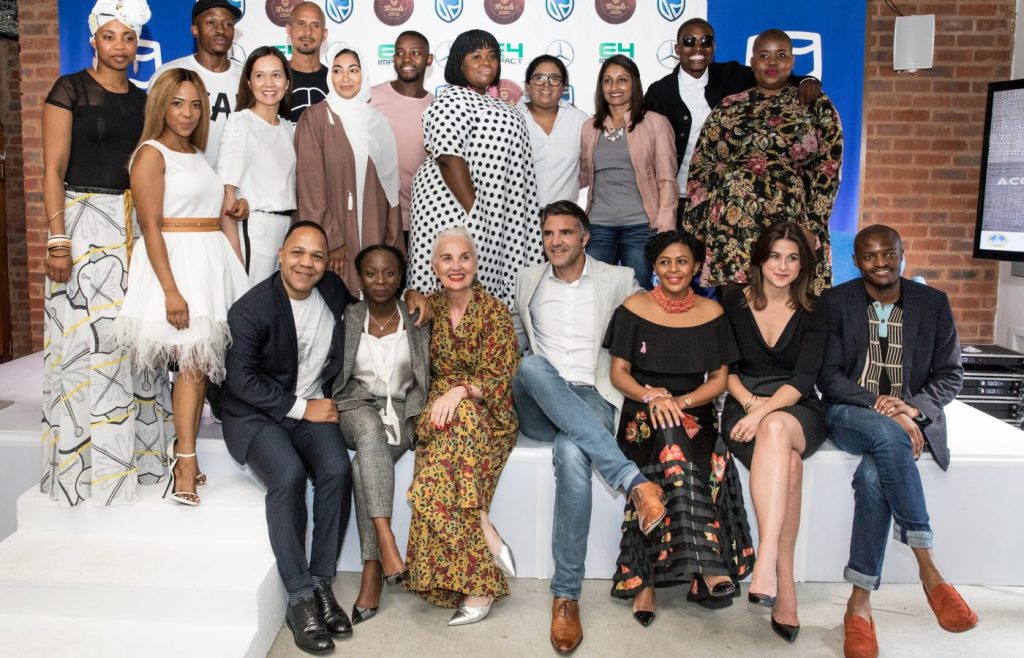
A new generation of fashion entrepreneurs
Moreover, we selected an esteemed panel of judges Laduma Ngxokolo of the brand MaXhosa, Timothy Maurice Webster – branding expert, Jackie Burger – former editor-in-chief of Elle Magazine SA and owner of Studio58, Basetsana Kumalo – businesswoman and Vincent Hoogduin, CEO of Spree.co.za (now superbalist.com). Their role was to asses the entrepreneurs’ overall progress, review their final business plans and through in-depth face-to-face interviews geared towards evaluating the current state of their business and commercial viability, their role was to select the winning entrepreneur for the year.
This program was most certainly intense and saw a fresh breed of new generation fashion entrepreneurs, that were willing to take up the hard-work and strive to grow their business and trade internationally.
On average, the entrepreneurs had been in operation for 2,5 years and were turning over in excess of 3 Million ZAR per annum. As a requirement of the program, all participants had to be the main manager or CEO of the business. And remarkably, besides running their own full-time businesses with some of our them having as many as three physical retail outlets, they came into their respective schooling hubs every Monday and Tuesday for 18 entire weeks, without fail.
And how were they selected?
We received over 400 qualified applications over a 1 month call-to-entry period during which they entered a 2-step application process.
Step 1. The applicants had to submit a 5 page online application form where they were tested on basic due diligence as well as business scenario case studies and financial literacy queries. Each question had an assigned grade and weight, and an independent panel of jury evaluated the questions without taking reference to the brand names or industry. The application form was separated in 2 parts : (1) due diligence and company references and (2) business questions, this was to ensure that non-mainstream brands or less-known brands wouldn’t be put at a disadvantage and that all companies were evaluated solely based on technical business capability and not the number of Instagram followers they had.
Step 2. Was an in-depth day-long assessment bootcamp that took place in all 4 of the learning hubs. A review committee comprising of key members of the fashion council, retail industry, magazine and publishing, as well as trade and export agencies would form part of this committee, and grade each applicant in a series of real-life business challenges in negotiation, sales, financial literacy and more. See the video below for more.
The entrepreneurs confirmed one of the biggest benefits of Threads was access to market and having obtaining the knowledge and confidence to grow their businesses
The Results
First, there was a winner.
Anthony Smith of 2Bop was the winner for this first edition! As part of his prize, he won a Mercedes Benz CLA to drive for 12 months, a Standard Bank Start-up SME Pack, the opportunity to pitch his products to the Spree.co.za online shop and retail from there, as well as, a trade trip to Europe, courtesy of Standard Bank.
Read more about his journey on our website www.wearethreads.com and soon to be revealed his trade trip to Europe with an exclusive pop-up store in Amsterdam in collaboration with Patta Brand, his expo stand at Seek Berlin and his inspiration journey at Paris Fashion Week!
But really, they all won. A few highlights:
The entrepreneurs confirmed one of the biggest benefits of Threads was access to market and having obtaining the knowledge and confidence to grow their businesses. But here’s a few of the highlights :
- Mamagasehome launched a new eCommerce Shop.
- La Manche capitalized on deadspace in her large retail store by expanding the brand and partnering with another brand to include children’s wear and women’s beauty. Thus increasing revenue through an additional rental stream.
- Tshepo The Jean Maker opened its first store in Lorentzville, Johannesburg.
- Hannah Grace Maternity acquired another maternity brand during the program. They now have 3 retail franchises and 2 brands : a premium and more affordable line.
Want to get involved?
If you’re reading this today, you can support our local talent by shopping with them – see links below, and if you love the initiative – we’re preparing for the 2019 edition in SA and the launch of the East African edition, feel free to get in touch with our head of media and partnerships Desiree Brouwer or by mail on desiree@nonzero-africa.com