
Funding for Women-owned Businesses in South Africa
- Updated on
- Home /
- SME Resources/
- Funding for Women-owned Businesses in South Africa
Table of content
Overview
Women own a large share of South Africa’s micro and small businesses, yet they receive a much smaller share of the finance that reaches the sector. That gap is the reason dedicated women-focused funds exist. It is also why preparation matters so much: when capital is scarce, the applications that get funded are the ones that arrive complete and clearly matched to what the funder backs.
This guide explains how funding for women-owned businesses works in South Africa: why the gap exists, the main types of finance open to women founders, what funders check before they approve an application, and how to get your business ready to apply. If you already know what you need and want to compare specific funds, go to our directory of female empowerment funds in South Africa, or our practical list of where to access funding for women-owned businesses.
Irene Ochem, founder and chief executive of the Africa Women Innovation and Entrepreneurship Forum (AWIEF), put the case for closing the gap plainly in an interview with SME South Africa:
“Unlocking the economic potential of women makes economic and social sense. It increases women’s bargaining power, positively affects economic growth and national incomes, makes for greater job and wealth creation and ultimately benefits the greater economy leading to a more inclusive and prosperous Africa.”
Why women-owned businesses struggle to access funding
The African Development Bank has estimated the financing gap for women-owned businesses across Africa at around USD 42 billion. In South Africa the pattern is the same: women are concentrated in micro and early-stage businesses, which are the least served part of the formal lending market, and the barriers they meet are structural rather than a question of ambition.
The most common obstacles are:
- Collateral. Women are less likely to hold property or assets in their own name, and most conventional lending is secured against exactly that.
- Networks. Much early-stage capital moves through personal and professional networks that women founders have historically been excluded from.
- Product design. Many finance products were built around larger, asset-heavy businesses and do not suit the size, sector or cash flow of the businesses women typically run.
- Time. Higher levels of domestic responsibility leave less time for the long, document-heavy application processes many funders run.
- Bias. Investment committees and credit teams remain largely male, which shapes how women-led businesses and the sectors they work in are assessed.
Download SME South Africa’s ‘Female Entrepreneurship & Funding’ Case Studies
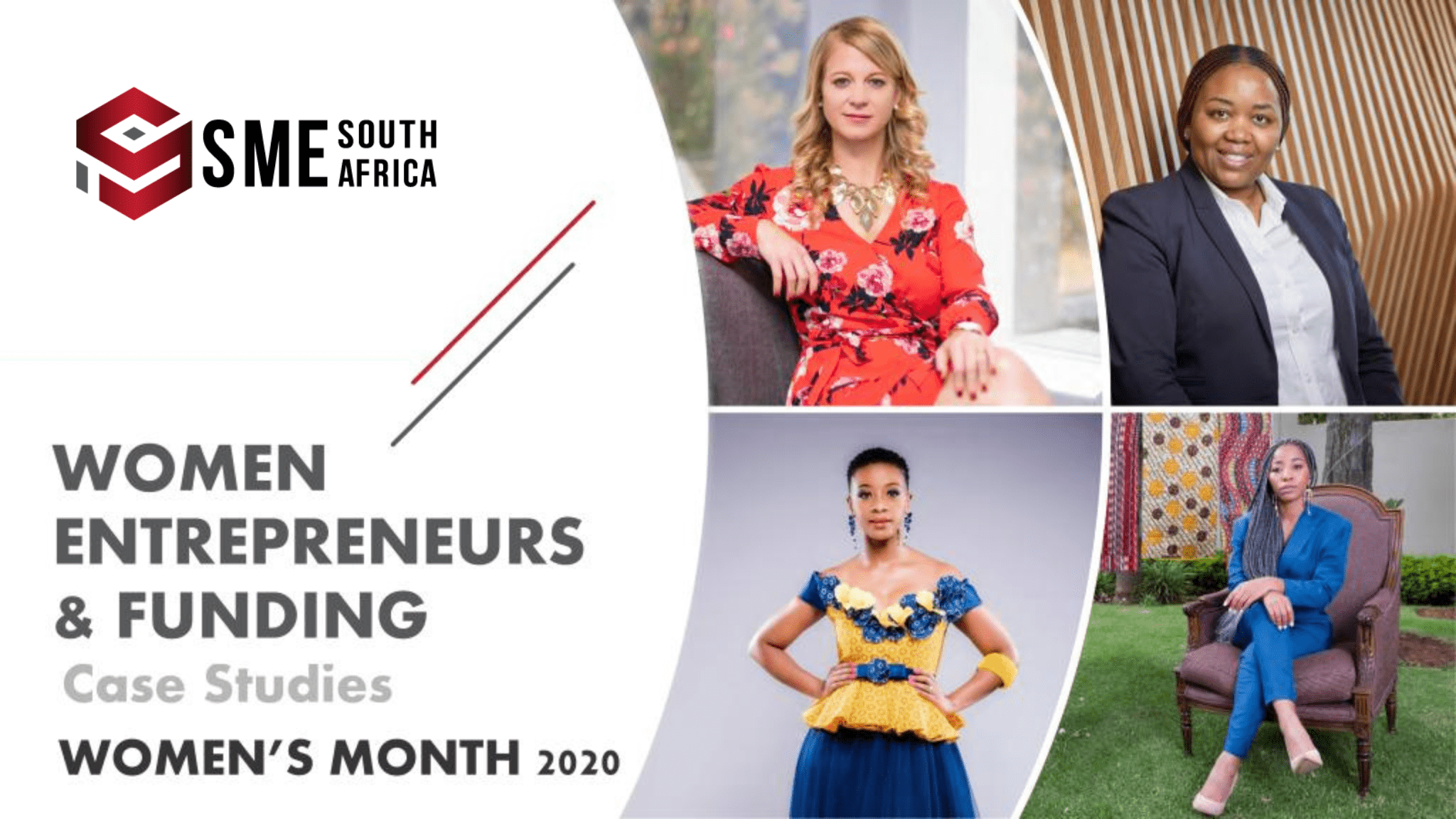 Learn more about the funding journeys of 4 local women entrepreneurs who are behind some of the country’s most Bankable, Scalable and Future-fit businesses.
What’s inside:
Learn more about the funding journeys of 4 local women entrepreneurs who are behind some of the country’s most Bankable, Scalable and Future-fit businesses.
What’s inside:
- The strategies they used to secure funding.
- The impact of business funding on their businesses’ growth.
- How they navigated the challenges they faced during the application process.
- Their advice for other female entrepreneurs.
Types of funding open to women-owned businesses
Funding for women-owned businesses is not one product. It comes in several forms, and each suits a different stage of business and a different need. Knowing which type you are after narrows the field quickly.
Targeted development finance
Government development finance institutions run funding windows reserved for women-owned businesses. They usually lend at lower rates than banks, accept earlier-stage businesses and often add business support. Most require majority women ownership, and some require black women ownership.Blended finance
Blended finance combines a grant with a concessional loan, so part of the money does not have to be repaid. It is becoming more common in public programmes because it lowers the risk for a young business.Specialist lenders and banks
Some commercial lenders offer products designed for women-owned businesses, sometimes with features such as a repayment holiday at the start. They expect an established business with financial statements and a record of turnover.Equity and angel investment
Gender-lens investors take a share of the business in exchange for capital and support. Equity suits businesses that can grow quickly and at scale. It means giving up part of the ownership, which can affect your eligibility for women-ownership criteria elsewhere.Grants, awards and competitions
Awards give non-repayable funding, but run on fixed annual cycles and are highly competitive. Treat them as a bonus, not a funding plan.Enterprise and supplier development
Large companies fund small suppliers through enterprise and supplier development programmes, often with a set-aside for women-owned businesses. These work best when your business can supply the corporate or its value chain. For the named funds, their amounts and where to apply, see our list of where to apply for funding for women-owned businesses and our guide to government and DFI female empowerment funds.How to get your business funding-ready
Most applications are decided on paperwork before anyone discusses the business itself. Have the following ready before you apply anywhere.
1. Proof of ownership and control
Women-focused funds verify ownership, not just the name on the application. Make sure your records with the Companies and Intellectual Property Commission are current and show the shareholding correctly, and keep your share register and share certificates up to date. Funders also want to see the women owners involved in running the business day to day, so be ready to show who holds which management role.2. B-BBEE status
Exempted micro-enterprises and majority black-owned qualifying small enterprises can confirm their B-BBEE level with a sworn affidavit instead of a full verification certificate. Our guide to B-BBEE explains which applies to your business.3. Tax and labour compliance
Almost every funder asks for a valid SARS tax compliance status PIN. Government programmes increasingly ask for UIF and COIDA registration as well. Sort these out early, since fixing an outstanding return can take weeks.4. Financial records
Expect to provide signed annual financial statements, recent management accounts and at least six months of business bank statements. If your business is too new for annual statements, a clean record of business bank statements and a realistic cash flow forecast carry more weight than projections alone.5. A business plan and a clear use of funds
Funders want to know exactly what the money will pay for and how it will be repaid or grow the business. Break the amount down line by line, attach quotes for equipment or stock, and show how the funding changes your revenue. Our business plan template gives you a structure to work from.6. Your own contribution
Be clear about what you are putting in, whether cash, equipment, time or existing customers. Funders read your own contribution as a measure of commitment, and it strengthens applications where collateral is thin.What funders check before they say yes
Whatever the fund, assessment comes down to a handful of questions: is the business viable, can it repay or grow, are the owners actively running it, and does it fit what this particular fund was set up to finance.
Applications are most often declined because:
- The business does not meet the fund’s ownership, sector, size or trading-history criteria.
- Documents are missing, out of date or inconsistent with each other.
- The financial records do not show enough income to support repayment.
- The use of funds is vague, or the amount requested has no clear link to what the business needs.
- Tax affairs are not in order.
Never pay anyone to access funding
Demand for women-focused funding attracts scammers who promise approval in exchange for an upfront “processing” or “facilitation” fee. Legitimate development funders do not charge you to apply.
- Apply directly through the funder’s official website or offices.
- Check that email addresses and phone numbers match the funder’s official site before you send documents.
- Be wary of anyone who guarantees approval, contacts you unsolicited, or asks for payment into a personal account.
Female entrepreneurship support networks
Support networks help women founders find funding opportunities early, prepare stronger applications and meet the people who make funding decisions.
She Leads Africa is a community and content platform for young African women entrepreneurs and professionals, across the continent and the diaspora.
AWIEF runs an annual conference, awards and accelerator programmes for women entrepreneurs across Africa.
Girlhype equips girls and young women from disadvantaged backgrounds with digital and coding skills for careers and businesses in technology.
SEDFA also provides non-financial support alongside its loans, from business training to mentorship, as set out in our look at SEDFA’s business development support.