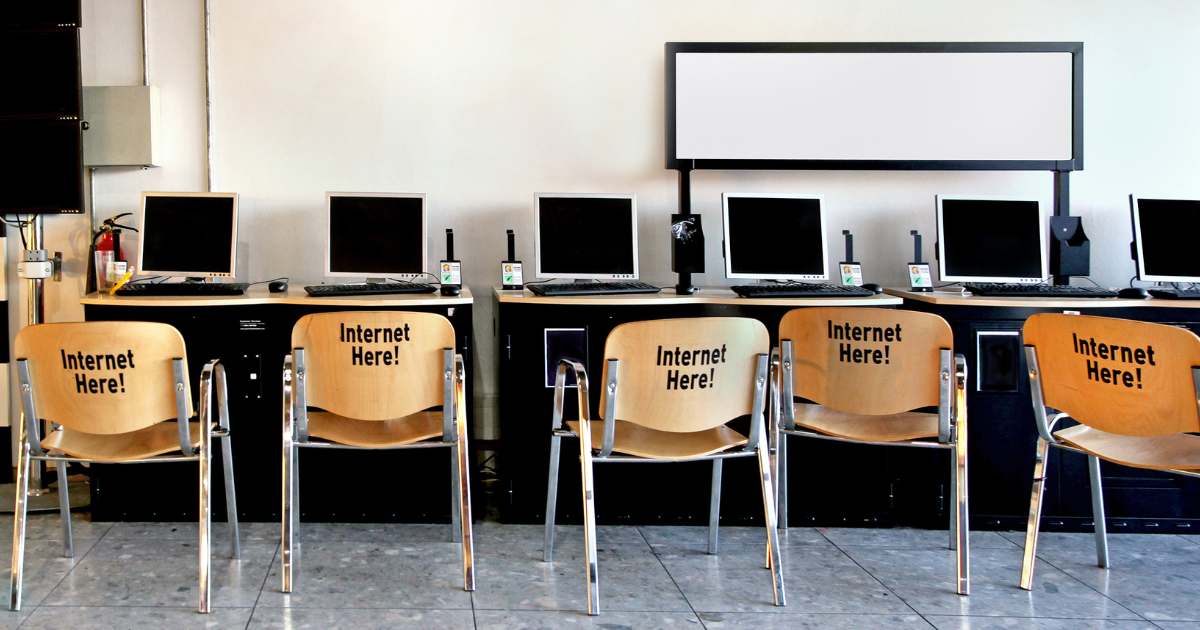
Access to the Internet is still not a reality for many South Africans. Many live in rural areas with an inconsistent supply of electricity and have yet to purchase smartphones. Although the country has over 51 million internet users, reflecting an internet penetration rate of approximately 79,6%, there is still a need for full-service Internet Café businesses.
Internet cafes are essential in providing digital services to communities. Not only can people access the Internet, but they can also print documents, get help with building their resumes and now, children go there to play on gaming consoles.
In this article, we look at what an internet café business is, how it works and what you would need to start your own.
What is an Internet Café Business?
An Internet Café (or cybercafé) is a retail business that provides customers with paid access to computers, high-speed internet, and digital services like printing, scanning, and document formatting. In many regions, they act as vital community digital hubs for individuals without personal devices or reliable home connectivity.
Internet Café Models
There are three main types of Internet cafes.
Traditional Internet Café
- Hourly computer rental
- Internet browsing and e-mail
- Gaming
- Basic printing and photocopying
- Low margins, high competitions
Modern Internet Café
- Focus on services people can’t do on their phones
- Document services such as printing, scanning and typing
- Government service such as SARS eFiling
- Job applications and CV creation
- Online learning and online course access
- Business services like e-mail, spreadsheets and presentations
Hybrid Internet Café
- Core services such as computers, printing and copying
- Mobile money agent and services
- Bill payments and airtime sales
- Photocopying and laminating
- Typing and document preparation
- Government form assistance
Compliance Requirements for Internet Café Business
Here are some of the regulatory requirements you will need to meet in order to open your business.
- Business Registration: You will need to register your business with the Companies and Intellectual Property Commission (CIPC).
- Tax Registration: You must register with the South African Revenue Services (SARS).
- Business License: You will need to obtain a business license from your local municipality.
- Commercial Premises: You need to get a formal lease agreement for your commercial premises. This will also be important when getting your business licence.
- Software Licenses: You must ensure you have software licenses such as Windows and Google Workspace or use free alternatives. If you opt for free alternatives, study up on their features so you can help customers easily.
- POPIA Compliance: Internet cafes can sometimes keep customer data on the computers. You need to ensure you have the correct cybersecurity tools in place to keep in line with the Protection of Personal Information Act (POPIA).
Starting Costs for an Internet Café
This is how much it could cost you to start an Internet café. Costs depend on the services you want to provide.
Computers: Cost of computers for around eight stations could be between R40 000 – R100 000. You can get second-hand computers, but they might not work as well.
Furniture: You will need desks and chairs behind the counter and at each computer station. You will need between R8 000 – R20 000.
Printer/Copier: For ultimate use, it’s recommended that you go for multifunction laser printers. These can cost you between R5 000 – R30 000.
Internet Installation: You will need a fibre line for a fixed LTE setup. This can cost you up to R5 000.
Networking Equipment: This is your network essentials, like routers, switches and cabling. This can cost you up to R8,000.
Backup Power: Due to the amount of loadshedding, you will need backup power to ensure your cybercafe runs smoothly. Depending on the amount of backup power you need, it can cost you between R5 000 to R30 000.
Security (Cameras and Premises Gates): You need to protect your business and equipment. To put in security resources like cameras or a gate would cost you between R3,000 to R15,000.
Software Licenses: This is the cost of the software licences, such as Windows, that you will use for your computers. This can cost you up to R15,000.
Shop Fitting and Signage: This includes things like the counter, partitions and branding. This will cost you up to R20,000.
Working Capital: This is the money you will need in the first three months of running the shop. This includes rent and supplies, and possibly an employee’s salary. You will need a minimum of R10 000 as your working capital.
The total startup cost of opening an Internet café is between R80 000 to R270 000.
Funding for an Internet Café
You can get funding for your Internet café through various avenues, including government grants, corporate development programs, and crowdfunding platforms.
Government and Enterprise Grants
- National Youth Development Agency (NYDA): The NYDA provides grant funding and business support for young South African entrepreneurs aged 18 to 35. You can apply for funding through the NYDA Portal.
- Small Enterprise Development and Finance Agency (SEDFA): SEDFA provides financial and non-financial support. Funding programmes such as the Spaza Shop Fund are available on the SEDFA website.
- National Empowerment Fund (NEF): The NEF offers various funding products aimed at black-owned businesses. The organisation has various funding programmes open for applications on its website.
Corporate Social Investment (CSI)
There are various CSI programmes supported by private sector organisations. One example is the Coca-Cola Beverages South Africa (CCBSA) Bizniz in a Box initiative. The initiative is a youth and women empowerment programme which helps build township and rural economies by developing black youth-owned businesses that are responsive to the needs of their communities.
To date, the programme has supported over 800 entrepreneurs across several provinces, including Limpopo, Gauteng, Mpumalanga, Eastern Cape and KwaZulu-Natal. And has provided over 1 200 structures – including 628 for young entrepreneurs – and spent more than R180 million on BiB-related activities.
Crowdfunding
Internet cafes provide essential digital services to communities, something most crowdfunding platforms support. You can set up a campaign on platforms like ThundaFund or Click ‘n Donate to raise initial capital.
Most Internet café owners bootstrap their businesses. However, there are many funding options to apply for, especially because the startup costs for an Internet café can be quite high. Also, look into getting donations for equipment from IT companies that have stock that could be used for a community-focused business like an Internet café.