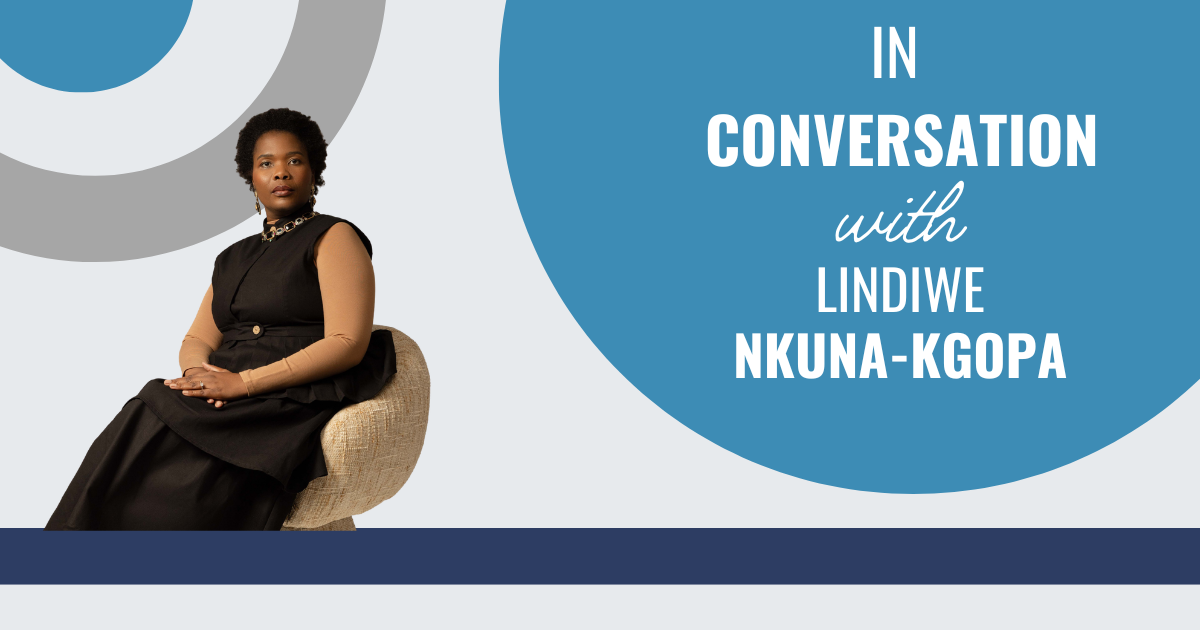
The days when South Africa had no women-owned sanitary pad companies operating at an industrial scale are now a thing of the past. Lindiwe Nkuna-Kgopa, founder and CEO of Lindiwe Sanitary Pads, took it upon herself to change the presence of women in the sanitary pad manufacturing industry.
“95% of the menstrual economy in South Africa is still controlled by multinational corporations, which means there is enormous room for locally owned, women-led manufacturers to take market share,” says Nkuna-Kgopa.
In this section of the SME founder focus, we profile Lindiwe Nkuna-Kgopa, the 2026 Veuve Clicquot Bold Woman Award winner. We dive into Nkuna-Kgopa’s journey, her biggest challenges, her wins, and the lessons she gained along the way.
From Social Issue to an Industrial-Scale Business
Lindiwe Nkuna-Kgopa is known for her drive for social change. However, in her efforts to make an impact in the lives of women across the continent, the goal wasn’t merely a social initiative. It became an opportunity to redefine the menstrual economy.
“I realised in doing the maths what our machine could actually do. At 800 pads a minute, across two eight-hour shifts a day, twenty days a month, we can produce over 1,15 million pads, more than 115 000 packs, every month,” she explains.
When she viewed that alongside South Africa’s National Sanitary Dignity Programme, which prioritises procurement from female-owned suppliers, and a menstrual hygiene market valued at over a billion rand, the scale of the opportunity became undeniable. It was no longer just a social initiative; it had evolved into an industrial-scale business poised to fill a significant market gap.
Turning Challenges Into Lessons
Every founder encounters a defining challenge in their journey that shifts how they approach business. For the founder of Lindiwe Sanitary Pads, one particular challenge taught her that boldness can be the missing piece to finding a solution.
“When our accounts ran empty and suppliers were out the door, I learned that boldness beats begging. Instead of going to our funders, hat in hand, I called their most senior people to come to us and see what we’d actually built. It taught me that credibility isn’t something you wait to be given; you build it, then you insist that people come and witness it. That lesson has shaped every negotiation since.”
That wasn’t all. Nkuna-Kgopa conquered other challenges, like meeting the capital requirements of the manufacturing industry.
“Manufacturing demands equipment, compliance and working capital that most funders aren’t structured to provide to a first-time, collateral-light founder.”
She overcame this by refusing to just apply and wait. She negotiated a key account management deal with Retail Development Solutions that put her products into over 2 000 stores, then requested high-level delegations from Absa and the IDC to visit our
factory in person.
“Presenting our plan on our own factory floor secured us over R27 million, R6 million from Absa and R12 million working capital plus R9 million CAPEX from the IDC, without collateral,” she explains.
Building Systems and People Who Carry the Business
We asked Lindiwe to reflect on her evolution as the founder of the business. She explained that the most fundamental aspect she had to unlearn was the instinct to do everything herself. From her early years in the business, she had to wear many hats, but that has changed as the business grew.
“I’ve had to unlearn the instinct to do everything myself. In the early years, I was the factory floor staff, the sales team and the finance department. As we’ve grown, my job has become building systems and people who can carry the business without me in every room.”
She explained that the business invested in a Chinese engineer, who was paid in US dollars for three years, not to run the factory but to transfer his expertise to her young South African team so the knowledge stayed after he left.
“We’ve also promoted from within. Team members like Clementine Chauke, who was trained up from cashier to quality controller, because the most revolutionary thing a business can do is invest in its people and mean it.”
Opportunities and Challenges for Women-led Manufacturing Businesses
While the opportunity for women-led manufacturing businesses is significant, Lindiwe believes access to the right kind of funding remains one of the biggest challenges.
“The challenge is that funding structures haven’t caught up to that opportunity yet. Manufacturing needs patient, collateral-free capital, and too few institutions are set up to offer it to women the way Absa and the IDC eventually did for us.”
Her experience securing funding for Lindiwe Sanitary Pads has shown her the importance of financial support that recognises the realities of manufacturing, particularly for first-time founders who may not have traditional forms of collateral.
The Future of Lindiwe Sanitary Pads
For Lindiwe Sanitary Pads, growth means more than expanding its customer base. Nkuna-Kgopa has a clear vision for the business. She aims to take the business beyond South Africa while continuing to build its impact across the continent.
“Success in the future looks like being listed on the JSE, which would give us long-term capital and credibility to match our ambition, and using the African Continental Free Trade Area to expand our footprint beyond South Africa’s borders.”
That expansion also includes the company’s social impact work. Through its partnership with Young Women of Africa, Nkuna-Kgopa wants to reach all 40 countries where YWoA has active chapters, growing from the eleven countries the sanitary product manufacturer currently reaches.
“We also want to build new strategic partnerships with global players who can bring us the technology and market access to keep scaling what we’ve built.” Nkuna-Kgopa’s achievement, along with her vision for the future, is a testament that commercial success and social impact do not have to exist separately.
Building a Business Where Purpose and Profit Work Together
“Don’t treat purpose and profit as competitors. Build them into the same model from day one.”
This powerful statement by Lindiwe Nkuna-Kgopa is reflected in the business’s impact work, from Buy to Donate to its partnership with Young Women of Africa. Rather than treating these initiatives as separate from the business, Nkuna-Kgopa sees them as part of how the company builds its brand and relationships.
Her journey has also taught her that building a purpose-driven business often means creating your own path, particularly when there is no clear roadmap to follow.
“And find your own version of what I found in the story of Madame Clicquot. Courage is borrowed from the women who built legacies before you, because none of us is given a map. We become the map for the woman coming after us.”