
The South African manufacturing industry is wrought with legislation and mandatory regulations – and with good reason. Not only is manufacturing one of the biggest industries in the country, but it is also one that is prone to danger. Heavy machinery and powerful equipment can cause serious injuries, so strict rules that protect employees are logical. But beyond complying, these businesses need to thrive competitively.
This is something that Small Enterprise Development and Finance Agency (SEDFA) understands clearly.
Marilyn Phele, Snr Manager: Quality Standards and Technology Transfer, explains that compliance has become a competitive advantage.
Compliance Equals Competitiveness
“Regulatory compliance in South Africa is utilised as a mechanism to accelerate competitiveness for small enterprises,” she says. “Structural mechanisms that translate into competitive advantage for small enterprises include operating as a formal CIPC-registered entity, being compliant with SARS (valid tax compliance status), and being registered on the Government Central Supplier Database as prerequisites for government tender bids.
“Furthermore, other mechanisms that may enhance small enterprises’ competitive edge are B-BBEE compliance, the Preferential Procurement System, the Enterprise and Supplier Development Programme for corporate procurement purposes and compliance with relevant sector laws and industry standards.”
She explains that small enterprises that treat regulatory compliance as a strategic strength rather than a weakness can assess new markets, pricing advantages and larger value chains scaling opportunities – and SEDFA is here to help.
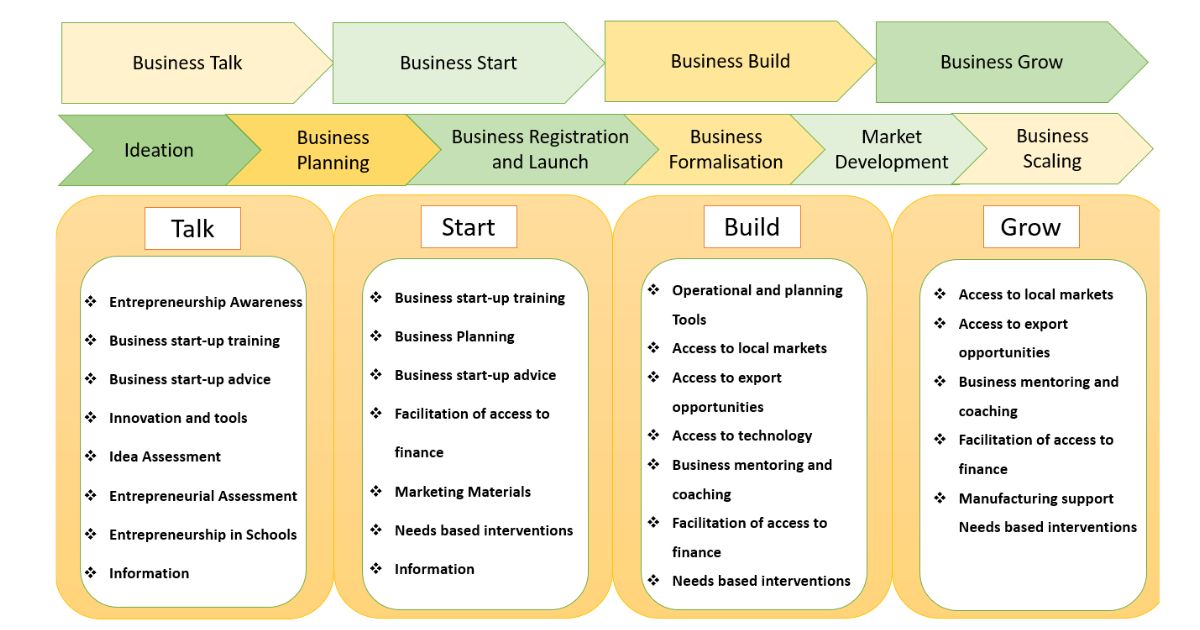
“The Small Enterprise Development and Finance Agency (SEDFA) provides regulatory compliance awareness workshops and training at each stage of our client’s business journey under our Business Development Support Programme, applying SEDFA’s client journey map; refer to the diagram below.
The Importance of Strategy in South Africa’s Manufacturing Landscape
Manufacturing is capital-intensive, has long investment lead times, has raw material inputs to the value chains, and has outputs to the local and international markets; thus, regulatory policies and strategies adopted today shape competitiveness for tomorrow and years to come.
“The implementation of localisation policies and strategies will accelerate market growth and ensure that compliant small enterprises have access to new markets. A manufacturer that builds its supply chain and documentation around local-content verification captures demand.
She continues to add that prioritising local content is crucial to South Africa’s manufacturing landscape; the manufacturers’ products must be verified for local content through SABS against the SANS 1286 standard for compliant small enterprises to gain leverage over their competitors and penetrate new markets.
SEDFA provides product testing support to small enterprises in partnership with SABS. Additional ecosystem partners are NRCS, SANAS, NMISA and others.
Navigating Compliance and Regulatory Requirements
Phele notes four points that make navigating compliance and regulatory requirements difficult.
- The cost of compliance and regulatory requirements can be deemed as expensive for small enterprises, while large enterprises have a dedicated annual budget allocation to cover and maintain sector regulatory compliance costs.
- Sector laws and industry standards, amendments to laws and standard reviews necessitate conformity to the changes implemented, and this usually has a financial implication on both small and large manufacturers.
- Access to correct regulatory compliance and industry standards information can negatively impact small manufacturers and restrict business growth.
- Consequences for non-compliance, i.e., SARS tax annual return penalty costs or factory closure by the authorities.
“SEDFA supports small enterprises with quality and conformity assessment activities to enable them to meet regulatory and industry standards and manage and operate their businesses effectively and efficiently, resulting in sustainable businesses,” Phele states. “Additionally, SEDFA funds MSMEs for product testing, product certification, management systems gap assessments, development, implementation, and certification. Furthermore, SEDFA hosts webinars in partnership with various stakeholders aimed at educating and bringing awareness on various quality and conformity issues, including ISO standards and others.”
This means that SMEs don’t need to feel like they are drowning in red tape.
Currently, SEDFA is also noticing a few trends among small manufacturers in South Africa.
“There are a few issues, but one that stands out is the manufacturing sector contraction pressure
“The manufacturing sector contributes around 12,5% of GDP but has been struggling to build momentum. Production declined 4,3% year-on-year in May 2026, with food and beverages, metals, and wood products taking a knock. This negatively impacts small manufacturers as they supply upstream, downstream and side streams of the manufacturing value chains under weak domestic demand and slow export recovery.
“Green practices are becoming a prerequisite for doing business with major retailers and international buyers. Section 12B renewable-energy tax deduction is another government structural mechanism aimed at enhancing the competitive advantage of small manufacturers.
“Lastly, digitalisation and AI adoption for competitiveness is another trend. Manufacturers are increasingly utilising AI to modernise production lines, reduce waste, improve efficiency and increase customer satisfaction.”
Phele states that SEDFA provides various blended financial support to small enterprises on AI adoption, i.e., manufacturing factory automation. Additional information and eligibility criteria can be found on the SEDFA website. Furthermore, SEDFA provides a Digital Kaizen Mentorship Programme in partnership with Productivity SA.
Tips for Small Manufacturers to Improve Compliance
Phele shares the following tips for small manufacturers looking to improve their compliance:
- Reframe regulatory compliance as market access, not overhead; Compliance converts into eligibility, access to market opportunities and strategic competitive advantage.
- Adherence to Retailer-Specific Requirements: Each leading retailer in South Africa may have distinct requirements, quality standards, and expectations for their suppliers. Familiarising yourself with these unique criteria is essential to align your business with their needs.
- Quality and Consistency: Retailers prioritise product quality, safety, and consistency. Meeting and exceeding these standards is essential to secure and maintain a good supplier relationship with leading retailers.
- Timely Response: Retailers often have structured deadlines and timelines for supplier evaluations and approvals. Ensuring that your business can meet these timeframes demonstrates professionalism and reliability.
- Online Resources: Retailers frequently make their supplier application and onboarding processes available online. These resources typically provide step-by-step instructions, necessary documentation, and contact details for enquiries. It’s imperative to thoroughly review and follow these guidelines.
- Transparency and Communication: Establishing clear lines of communication with the retailer is crucial. Be prepared to engage with their procurement and compliance teams to discuss your capabilities, product offerings, and how you can meet their requirements.
“SEDFA provides regulatory compliance awareness workshops and training to small enterprises. The sessions cover South Africa’s quality infrastructure, including the roles of SABS, NRCS, SANAS and NMISA.”
Among these key topics, they also dive into mandatory versus voluntary standards, regulations, product testing, certification processes and ISO standards. Participants are also introduced to the Quality and Standards Programme offerings, including support for product testing, quality management systems and intellectual property protection, helping to strengthen their understanding of compliance, quality improvement and market access opportunities for MSMEs.