
A business model canvas is a tool that describes how a business intends to make money. It explains who your customer base is how you deliver value to them and related details of financing. The business model canvas lest you define these different components on a single document. It is better than the ordinary business plan that goes across several pages, it offers a much easier way to understand the different core elements of a business.
What Are the Benefits of Using a Business Model Canvas?
The business model canvas (BMC) offers various benefits for entrepreneurs and small businesses. It is a valuable tool that provides a visual representation, structure, and approach to designing, analysing, optimising, and communicating your business model.
- The business model canvas provides a detailed overview of a business model’s essential aspects.
- The overview ensures that the team considers all required components of their business model and can identify the gaps or areas of improvement.
- The BMC allows the team to have a broad and shared understanding of the business model and allows them to align and collaborate effectively.
- The BMC facilitates discussions among the team members, investors, partners, customers, and other stakeholders.
- The BMC template can guide brainstorming sessions to generate insights and ideas to refine to make strategic decisions.
- The BMC provides a structured approach for a business to explore possibilities and experiment with new ideas.
How to Make a Business Model Canvas
Here’s a step-by-step guide on how to create a business canvas model.
Step 1: Gather your team and the required material – Create a team from within your organisation that will work together. It is better if you can get a diverse group to cover all areas.
Even though you can make use of whiteboards, sticky notes, and markers to create a business model canvas, using an online platform like Creately would mean that any changes made can be accessed from anywhere at any time. Open Creately; create a workspace and start giving people editing/reviewing permission.
Step 2: Set the context clearly – Define the purpose and the scope of what you want to map out and visualise in the business model canvas. Narrow down your business or idea with the team and its context.
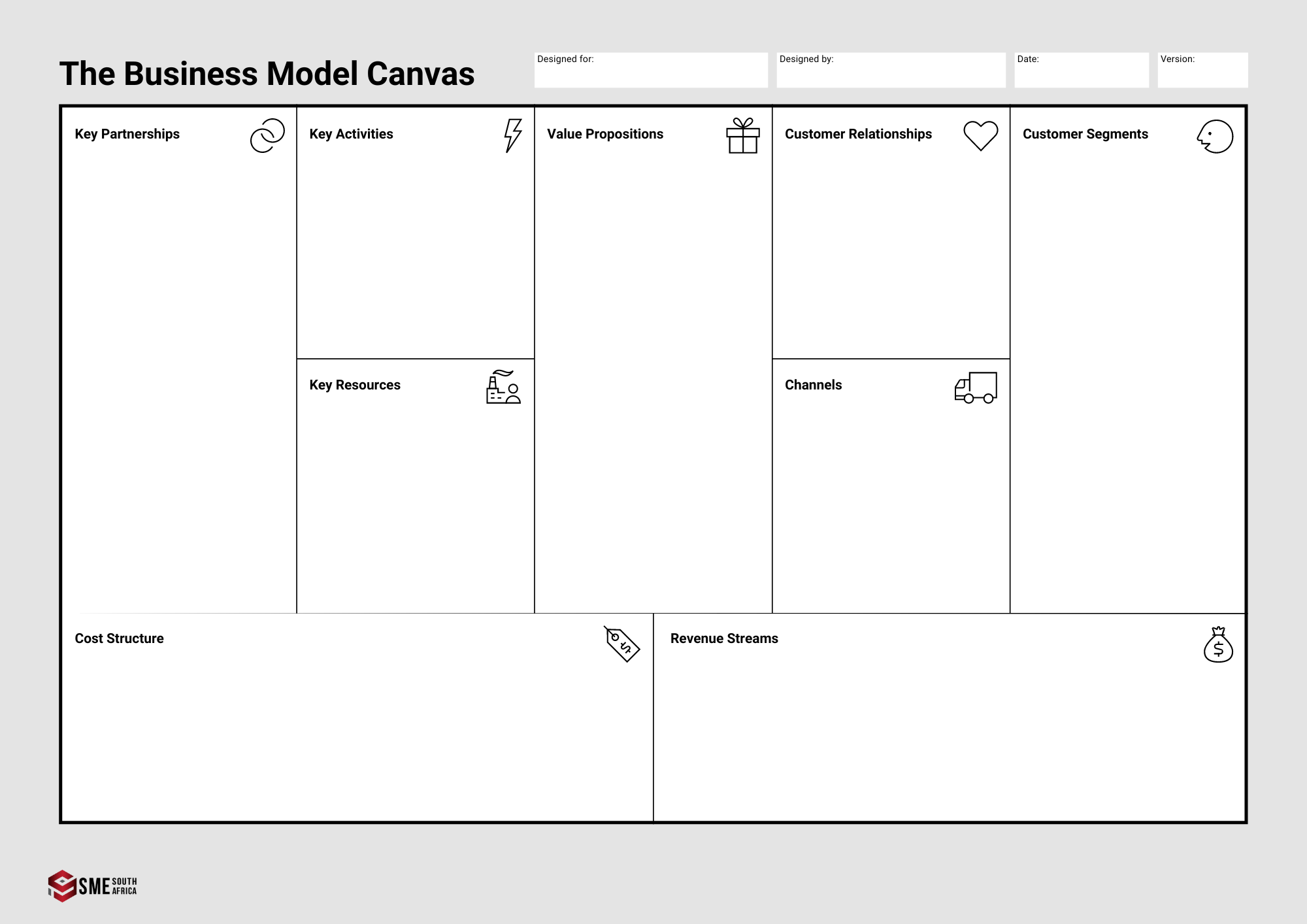
Step 3: Draw the business model canvas – Divide your workspace into nine sections equal in size to represent them by nine building blocks of the business model canvas.
Step 4: Pinpoint key building blocks – Title every building block as Customer segments, Value propositions, Channels, Customer relationships, Revenue streams, Key Resources, Key Activities, and Cost structure.
Step 5: Fill in the canvas – Each section should be filled by each team member where they belong. Any ideas and thoughts may be represented by data, keywords diagrams, etc.
Step 6: Analyse and run through again – As soon as your team has completed the business model canvas, look at the relationships therein to identify strengths, weaknesses, opportunities, and threats. Discuss elements to make the business better and make changes where necessary.
Step 7: Finalise – After that finalise it and use it as a visual tool for communicating the alignment of your business model with stakeholders. You can also use the model to support informed decision-making or strategic action within your business.
What Are the Nine Building Blocks of the Business Model Canvas
There are nine key building blocks in the business model canvas and they are:
1. Customer Segments
2. Customer relationships
3. Channels
4. Revenue Streams
5. Key Activities
6. Key Resources
7. Key Partners
8. Cost Structure
9. Value Proposition
The business model canvas is a strong aid in developing and fine-tuning business strategies. A thorough understanding of its key components, and how it can be effectively implemented along with its pros and cons enables organisations to manage through the complexities of their market environment easily to guarantee sustainable profitability.
