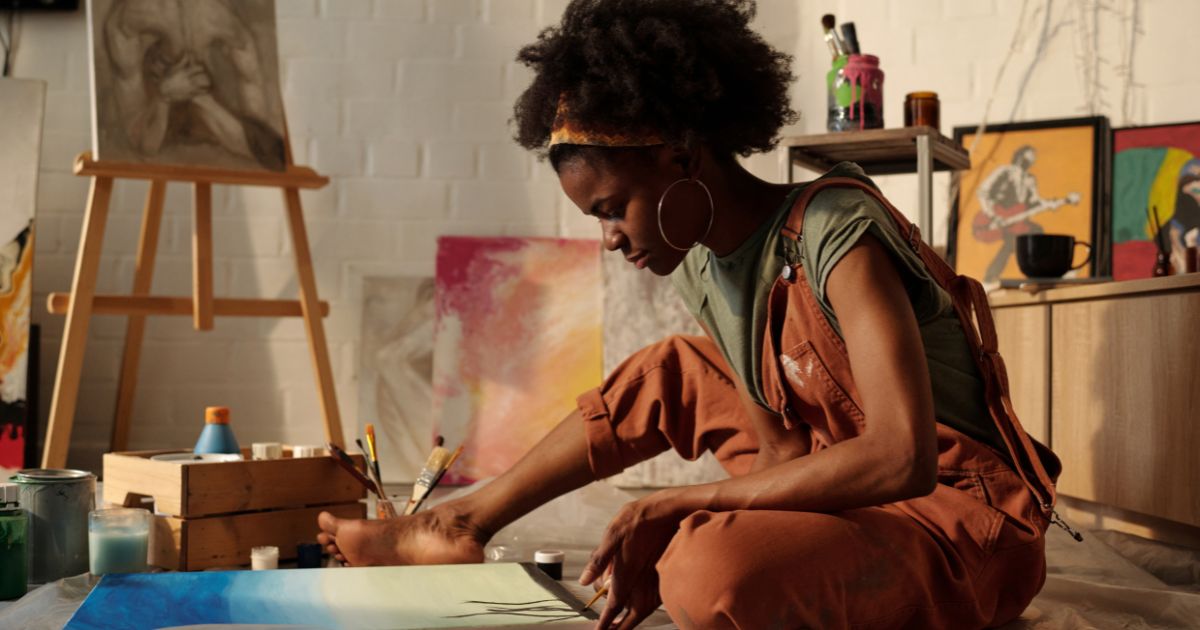
Artists understand this feeling better than anyone else: people look at your creations, compliment the skill it took to create, and then ask what your real job is. And you? You suppress the side eye and think, “This is my vocation.”
According to Teresa Lizamore, a gallerist, curator and long-time custodian of corporate and private art collections, this is a common occurrence in the creative economy, and it raises a bigger question. She poses the question: When do you become an artist?
“You become an artist the moment you put yourself out there as an artist,” Lizamore declares. “In order not to be seen as a hobbyist, you need to take yourself seriously.”
She notes that both career-educated artists and self-taught artists fall under this definition, but it depends entirely on what you create. “As an artist, you work with energy, so anything that you create is for the reader or the viewer to interpret or to read or to get moved by it. It depends on how the audience is going to respond to it
The First Steps to Creative Entrepreneurship
Lizamore explains that artists who take themselves seriously and put themselves out there need to build their careers seriously.
1. Start With Professionalism
“You’ve got to learn about professionalism and how the industry works. You must be consistent. And building a career is a gradual process,” she adds. “I worked with artists when they were young in their career, and now they are in their fifties and only getting recognition now. Not all artists are successful in the early stage of their career. Eventually, the market will respond.
She acknowledges that this takes endurance and requires the artist to reframe what success means. “A journalist once said to me that success is based on perseverance; it’s about never ever giving up, accepting the challenges, and working with it.”
Her advice is to:
- Work on a concept, something important or personal that you can be recognised for. Work on developing this concept or theme, and the narrative within it.
- Make sure your work is finished. Works should be presented in their final form to potential buyers, such as having the backing finished, the art (if necessary) framed and all the finishing touches completed.
- Be on time for gallery or client meetings. Your artwork should also be completed on time
- Have high-resolution images available to share on request.
2. Understand Pricing
Lizamore notes that many artists aren’t business people; they enter the creator economy because of their art, not some passion for entrepreneurship. “New, young artists enter the market, and they think that they can price the world for their creations because they are so important and put so much time and effort into it.” The reality is much harder than that. “You only become important when people start recognising your work and start buying it because they really believe in it
“It’s supply and demand.”
Galleries are there to help artists gain knowledge on the industry and be mentored. Lizamore says that this also extends to pricing works correctly.
“I always also tell my artists that if you want to show on social media or someone comes to your studio, make sure you have a consistent market price across your studio and exhibition spaces,” she adds.
Challenges the Creator Economy Faces
“Artists must realise that the market is saturated. The reality is that an investor will look at the price and determine what they can buy for that same price from an established artist or auction house.
“You have to make yourself unique and different.”
She notes that, currently, the market is moving away from overdone township scenes or sad imagery towards visual art that stands out among those themes. “We need to go back to serious art, not just pretty pictures. It needs to have so much more content and history and storytelling and soul.” The emphasis here is to move beyond the ordinary, or commonplace, imagery that isn’t fresh or new. What new lens is a creator bringing to a story, or what new story is being told in a new way?
African art has also put South Africa on the map, simply because of the diverse cultural landscape. “We need to consider and take into account that even coporates are not building collections like they used to. On the one hand, this is because of the financial landscape, but also because they are running out of space.” However, private collectors or rising businesses are still a part of the conversation. She advises artists to understand that collectors are not just looking at taste but at content, that the art is speaking towards the collection as a whole.
Digital Art Makes the Creative Economy More Accessible
Lizamore reminds readers that digital art is a highly specialised field of art because it requires a lot of skill and training (practice, too), to create the end result. “The advantage of digital art is that you can buy it at a lower price than, for instance, an oil painting. All mediums are applicable,” she adds, pointing out how artists are increasingly using mixed media to create their pieces.
Along with digital art, the conversation turns to AI and whether it will replace artists, but Lizamore has an interesting view about this: “AI is here to stay, but it will improve,” she elaborates. “But you will still be able to see what is AI and what is digital art.
“At the end of the day, it’s a matter of taste whether you like it or not.”