Groundnut, or peanut, production in South Africa is a fascinating business. Not just because everyone seems to love peanuts and peanut butter. And it all starts with a tiny seed in one of the drier parts of South Africa.
As with most crop types, becoming an angripreneur can be expensive, yet rewarding. Peanuts are no different. Capital expenditure for your initial investment can be high, but with a good year and sound business management, it’s still an industry you could enter. The only “if’ is that, like many crops, where you are based determines what crops your climate will allow you to grow.
The South African Peanut Market
Groundnuts are a vital food source and are often found in the peanut butter and snack markets, but they are also used for producing oil. Locally produced peanuts are exported to Europe and Japan, but a large portion also makes it to our grocery baskets.
The peanut market is valued at USD 1012,41 million in 2025 and continues to grow. In the next five years (2026-2034), it’s predicted to increase at a CAGR of 3,72%.
The value chain consists of farmers, commodity traders, manufacturers, and ultimately, retailers.
Peanut production in Southern Africa is usually concentrated in the Northwest, Northern Cape, Free State and Limpopo provinces. Depending on where the farm is located, farmers rely on irrigation rather than dryland farming. Planting begins in October to December, with the subsequent harvest taking place from April to June.
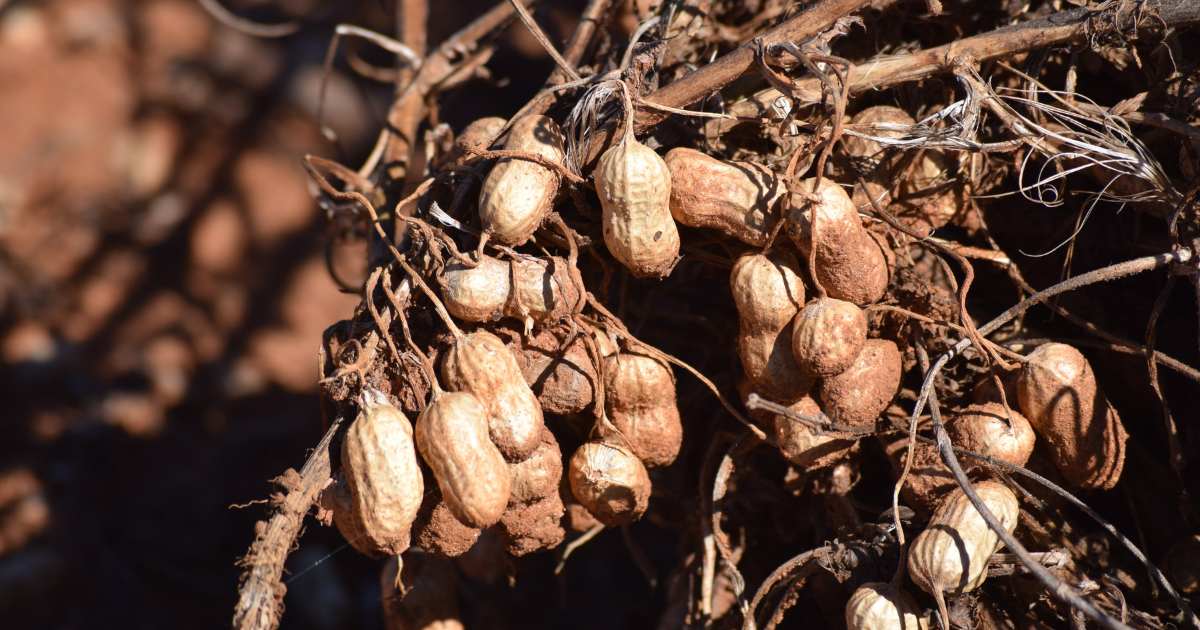
Unlike tree nuts that grow on trees, peanuts develop underground in bushels. Their taproot system can reach up to 1,8 metres in depth, depending on the soil. However, these plants prefer soils that drain well, such as sandy to sandy-loam soils, with a slightly acidic pH range between 5,5 to 7
Groundnut Farming in South Africa
Groundnuts (Arachis hypogaea L.) are divided into two groups, namely the Virginia and Spanish-Valencia groups. According to Albé Koen, CEO of Triotrade, the Spanish variety is preferred in South Africa because it has a shorter growing period. “In South Africa, it will grow for 150 days, which means we would start planting from the 20th of October until the end of November, and then we start harvesting, basically from the 20th of March up until mid-May.”
Visiting peanut producers in Schweiser-Reneke who supply groundnuts to Triotrade, Koen explained how the harvesting happens. “The farmers start digging the peanuts with a peanut digger, a specialised implement. It has a blade underneath that cuts the root and takes the plant out of the soil. It will then lie in the sun for 3 to 5 days, at which point the harvester will be used to remove the pods from the actual plant,” he explains.
He shares that harvesting can be done in one of two ways. The first is mechanical, as mentioned above, but the second is by hand. “You have a team of labourers pulling each plant by hand and packing it in heaps to dry on the land. In that method, the heaps remain on the land for about three weeks until they are put through a harvester that strips the pod from the plant.”
At this point, the farmer will sell the harvested crop to commodity traders like Triotrade or to processing plants.
What happens next is drying and further processing. “It needs to be cleaned, dried and further processed to be turned into the snacks and food items you buy in your local supermarket.”
Starting Peanut Farming
If you decide to start farming with peanuts, there are quite a few elements to consider. Start with your market research to find out what size land you need to acquire, whether you are renting or buying. Remember, you will need to be located in an area that has the right climatic conditions for growing groundnuts.
Set up a budget and business plan that looks at the costs of purchasing peanut seed (this is the peanuts that are specially grown for becoming seed), the cost of renting or buying planting equipment, fertiliser, and how much you need to allocate to labourers if you choose to use them.
This will help determine what the start-up cost of your farm will be.
NOTE: Any type of farming involves many risks. Not only are you delivered to the whims of nature, but you are also exposed to pests and diseases.
Pests include African bollworm (Helicoverpa armigera), thrips causing leaf distortion and stunted growth, nematodes and aphids.
Diseases include Groundnut rust (Puccinia arachidis) and Aspergillus crown rot (Aspergillus flavus).
Distribution and Market Access
Unlike other types of businesses, agriculture market access relies on agricultural supply chains, distributors and processors across the value chain.
Here you have two options: Either sell your nuts in-shell to local suppliers or sell them to a manufacturer for further processing.
During your research stage, you will also need to consider this. Is there a trader in your area? Is there a company that can provide a letter of intent for purchasing your crop upon harvest? If so, then you need to ensure that you negotiate the terms of pricing, as well as the expected quality of the yield.
Obtain Funding and Equipment
As mentioned above, the initial capital investment can be quite high. Thankfully, South Africa has a strong agricultural sector, and there are many institutions that offer agricultural funding. For this reason, your business plan should thoroughly explain how your business will operate, what initial input costs it will take, and what your expected income will be.
Educate Yourself
If you haven’t worked with groundnuts before, it is a good idea to invest in educating yourself. This doesn’t have to be a formal university education, but it can also mean that you find a mentor who can show you the ropes. Agricultural role players like Grain SA also offer resources to help you with peanut production.
There is still a chance to build a successful business from peanut farming in South Africa. However, you must consider the risks and pay careful attention to the climatic requirements of this specialised crop.