People lie in surveys. They do not lie in downloads.
Ask a business owner how they are doing and you will get a confident answer. Watch what they quietly download at eleven at night, and you learn where they are actually stuck. Nobody downloads a cash flow forecast template for entertainment.
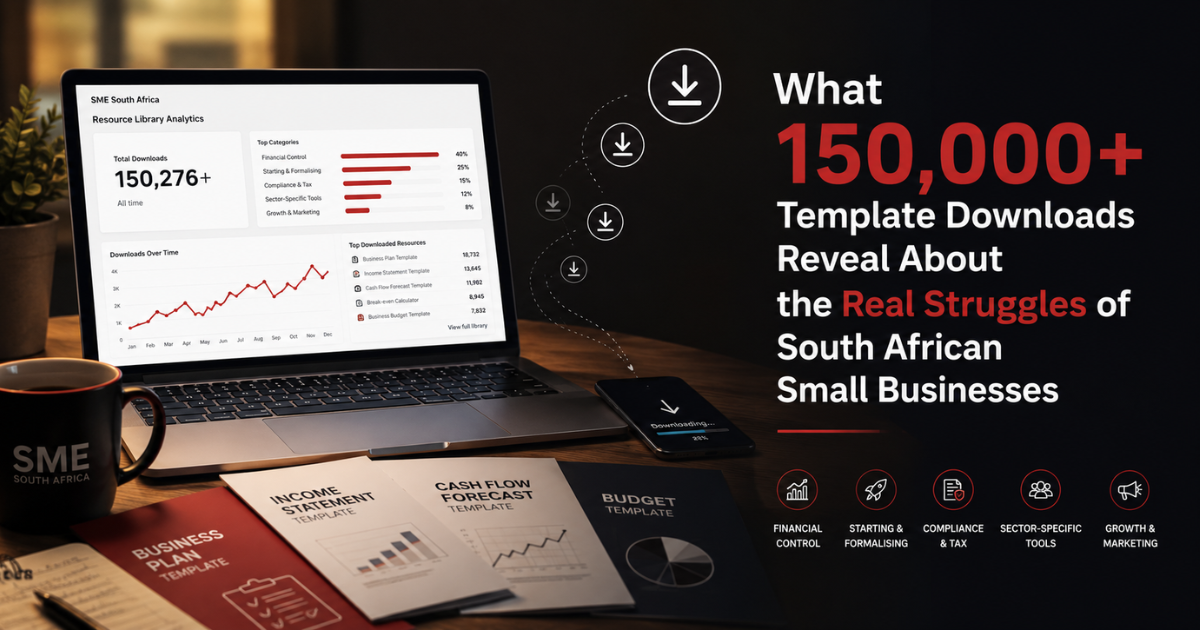
Across the SME South Africa resource library, small business owners have pulled down more than 150,000 free templates, guides and reports. That is a large, unfiltered signal of where the pain sits in the South African SME economy. When you rank what they reach for, three themes emerge, and every one of them connects back to money.
The ranking: financial control dominates
Grouped by what the resource actually helps a business do, the demand distributes roughly like this:
| What the resource helps with | Share of downloads |
|---|---|
| Financial control (income statements, cash flow, breakeven, budgets) | Over 40% |
| Starting and formalising a business (business plans, startup checklists) | Roughly 25% |
| Compliance and tax (VAT, SARS-readiness, employment documents) | Roughly 15% |
| Sector-specific tools (retail stock lists, agriculture funding guides) | Roughly 12% |
| Growth and marketing | Under 10% |
The single most downloaded individual resource in the library is a business plan template, by a wide margin. Behind it sit the income statement, the cash flow forecast, the breakeven calculator and the business budget. Four of the top five most-downloaded tools are about one thing: understanding your own numbers.
Struggle one: business owners cannot see their own money
This is the headline finding, and it deserves to be said plainly. The largest single cluster of downloads across the entire library is financial control.
Small business owners in South Africa are not short of hustle. They are short of visibility. They know roughly what came in this month. They know roughly what went out. What most cannot tell you, without going and looking, is whether they made money, what their breakeven point is, or whether they will be able to cover next month’s stock order.
That gap is expensive in two ways. In the short term it leads to decisions made on gut feel, pricing that quietly loses money, and cash surprises that arrive too late to manage. In the long term it is the single biggest reason businesses cannot get funded. When we analysed the applications through our Funding Desk, more than half were declined, and behind most declines was a business a lender simply could not read.
The people downloading cash flow forecasts today are the same people who will apply for funding in eighteen months. Whether those numbers are in order is what will decide the answer.
Struggle two: getting started, properly
The second cluster is about formalisation. Business plan templates, startup checklists, guides to business ideas. Roughly a quarter of all downloads sit here.
This tells us a large share of the audience is at the very beginning, trying to turn something they already do into something a bank, a funder or a corporate client will take seriously. The instinct is right. Formalisation is what converts a hustle into an entity that can open a business bank account, register with the Companies and Intellectual Property Commission, invoice a corporate, and eventually borrow.
Whether every one of them needs a forty-page business plan is a separate debate, and one we have had before in do you need a business plan, yes or no?. What is not debatable is that a business which cannot describe its own economics on paper will struggle to convince anyone else of them.
Struggle three: compliance is a constant, low-grade tax on attention
Roughly one in seven downloads relates to compliance and tax. VAT guidance, SARS readiness, contracts of employment, employee information sheets.
This is the invisible workload of running a South African business. It generates no revenue, it cannot be skipped, and getting it wrong is expensive. The South African Revenue Service has steadily digitised its processes, which helps, but the administrative burden on a small owner-managed business remains real, and the download data shows owners actively seeking help with it rather than ignoring it.
The pattern nobody talks about: sector-specific tools travel furthest
One finding surprised us. A stock list template built specifically for spaza shops, and a funding guide written specifically for agriculture, both perform far above what their apparent niche would suggest.
This is a reminder that a very large part of the real South African SME economy is informal and semi-formal retail, and agriculture. These businesses are frequently written out of the mainstream small business conversation, which is aimed at a professionalised urban founder who is not, statistically, the typical South African business owner. Give that owner a tool built for their world, in their language, and they use it.
It is a lesson we have taken seriously in how we build our own business guides.
What to do with this if you are a business owner
The download data is essentially a map of what other people in your position are struggling with. Use it.
Start with visibility, not growth. Before the marketing plan, before the new product line, get an income statement and a cash flow forecast that you actually update. You cannot grow what you cannot measure, and you certainly cannot fund it.
Know your breakeven number. Most owners cannot state theirs. It is the single most clarifying number in a small business, because it tells you exactly how much you must sell before anything you do is worth doing.
Separate your accounts. A dedicated business bank account is the cheapest, fastest improvement most informal businesses can make to their fundability.
Treat compliance as maintenance, not crisis. An hour a month costs less than a week in March.
Then, and only then, go looking for capital. The path from a template to a funded business is a real one. We watch businesses walk it. It just runs in that order, and almost never in reverse.
The bottom line
Financial literacy, not ideas and arguably not even access to capital, is the real bottleneck in the South African SME economy. Capital is available, imperfectly and unevenly, but it is available. What is missing, in hundreds of thousands of small businesses, is the ability to present a clear financial picture to the people holding it.
That is a solvable problem, and it starts with a free template and an honest afternoon.
Browse the free tools in our resource library, and when your numbers are ready, see what you qualify for through the SME South Africa Funding Desk.
About this analysis: figures are drawn from downloads across the SME South Africa resource library. All data is aggregated and anonymised.