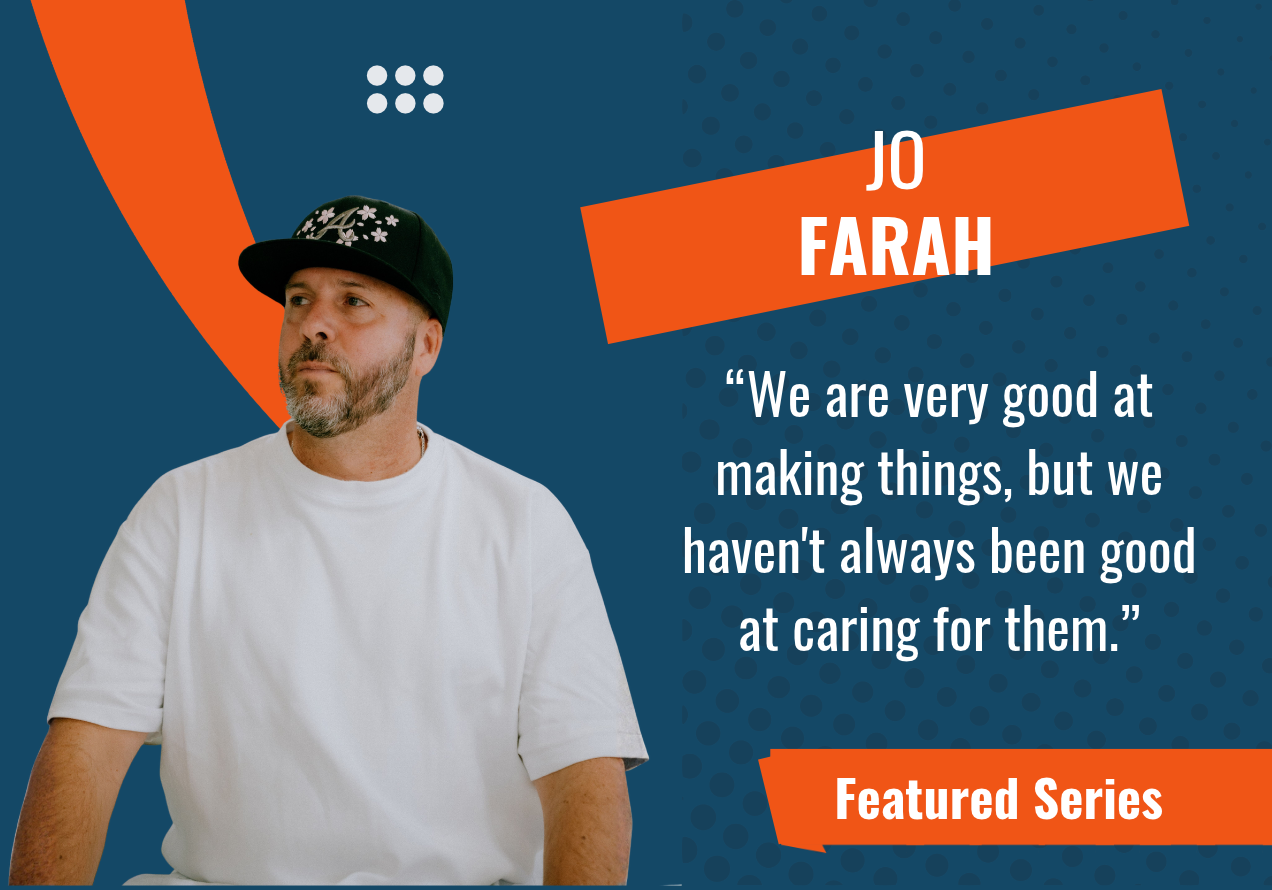
 Bacteria are microscopic living organisms that play an essential role in the natural world. While some can cause illness, many others are beneficial and contribute to the ecosystems that support life. We have traditionally viewed bacteria as something to eliminate, but a deeper understanding of microbiology reveals a more complex picture. Supporting beneficial microorganisms and understanding their relationship with other microorganisms opens up an entirely different way of thinking about cleaning, care and wellbeing. It was this thinking that sparked the interest of Jo Farah, founder of The Lab and GoodBasics.
“We tend to think of bacteria as something we need to get rid of, but the natural world depends on complex biological systems working together. Not all bacteria are bad, and understanding that distinction opens up some interesting possibilities,” he explains.
“This got me thinking about how biotechnology could change the way we approach everyday cleaning and care. I realised there was an opportunity to use beneficial microbes to do more than simply remove dirt. We could create products that continued working long after they were applied. More importantly, I started looking at where else this science could make a difference.”
Farah’s background across sales, technology, marketing and the fashion industry gave him an understanding of consumer behaviour and an ability to identify opportunities where conventional thinking could be challenged. This led to the creation of Sneaker LAB, now The Lab, a brand built around applying biotechnology to the care and preservation of footwear, apparel and other products people value.
Having established The Lab around the idea of using biotechnology to care for and preserve the things we value, Farah began exploring how the same underlying science could be applied to the environments in which we live. GoodBasics was born from that thinking: an opportunity to take biotechnology beyond product care and into everyday cleaning, personal care and wellbeing.
Rethinking the Way We Clean
Farah’s interest was not simply in developing another cleaning product. It was in challenging the conventional thinking behind cleaning itself.
“For generations, cleaning has largely been associated with removing dirt and eliminating microorganisms. But the science of microbiology presents a more nuanced picture. Not every microorganism is harmful, and maintaining a clean environment doesn’t necessarily mean eliminating everything living within it.”
Traditional cleaning products serve important purposes, and there are times when disinfection is necessary. However, Farah believes there is an opportunity to take a more considered approach to everyday cleaning, one that combines effective cleaning with an understanding of the microbial environments around us.
“Longevity is an important part of the conversation,” Farah notes. “The longer we can use and enjoy the things we buy, the less frequently we need to replace them. That can benefit both the consumer and the environment by reducing waste and the resources required to manufacture replacements.”
He believes this philosophy extends beyond the products we own to the spaces in which we live and the products we use every day.
“We have become very good at making things, but we haven’t always been as good at caring for them. I believe there is a better way to clean, care for and preserve the things and environments we value.”
Stumbling into Entrepreneurship
Farah didn’t set out to become an entrepreneur.
“I was interested in business, technology, marketing and understanding what makes people tick. Entrepreneurship became the vehicle through which I brought those interests together.
“I enjoy taking an idea, challenging the conventional way of doing things and building something that didn’t exist before. I’ve always been comfortable looking at a category and asking whether there is a completely different way of approaching it.”
Over time, Farah’s interest has shifted from simply building businesses to building businesses that make a meaningful difference.
“Commercial success matters because it allows you to keep investing, innovating and reaching more people. I have always believed that if you want to create meaningful change, you need to build a sustainable business around the idea.”
Of course, having a vision is only the beginning. Building a business requires the right people, investment, research, execution and the ability to adapt.
“One of the most important parts of my role has been identifying opportunities, developing the vision and bringing together the people and capabilities needed to turn an idea into a viable business. My teams have been instrumental in translating those ideas into products, developing the science and building the operational capabilities behind them.
“The underlying thinking connecting The Lab and GoodBasics has always been the application of biotechnology to find better ways of caring for the things and environments that matter to us. They are different businesses, addressing different consumer needs, but they share that common philosophy.”
The Science Behind GoodBasics
“Not all bacteria are harmful,” Farah highlights. “Many play important roles in natural ecosystems and in the human body. I think it is worth moving beyond the idea that everything microscopic is something we need to eliminate.”
GoodBasics uses selected beneficial microorganisms and their natural biological activity to support effective cleaning and a more considered approach to the microbial environment.
“The probiotic bacteria in our formulations produce enzymes that help break down organic matter, including residues associated with dirt and unpleasant odours. The beneficial microbes can also compete with other microorganisms for space and resources. This helps explain how probiotic cleaning can continue working after the initial application, rather than relying entirely on a one-off cleaning action.”
The technology can remain active for up to 10 days, with our testing showing that the product reaches peak efficacy at 72 hours. This is the basis of our commercial claim, highlighting the continued activity of the beneficial microbes and their ability to break down organic residues long after the initial application.
“For us, this was an opportunity to create a genuinely different proposition in the market. We weren’t interested in simply creating another cleaning product with a different fragrance or packaging. We wanted to build a platform around the science and explore how it could be applied across different aspects of everyday life.”
This thinking sits at the heart of GoodBasics’ Microbiome Support™ philosophy.
“The bigger idea behind Microbiome Support™ is that hygiene and microbial balance don’t always have to be opposing goals. By combining effective cleaning with selected beneficial microbes, we can take a different approach to maintaining the spaces we live in.
“We spend a lot of time thinking about what we put into our bodies, but much less time thinking about our spaces and the products we use every day. I believe that deserves more attention.”
And the opportunity extends beyond household cleaning. The same underlying biotechnology can be explored across different aspects of everyday life, from the spaces we inhabit to the products we use on our bodies and around our pets. GoodBasics is being developed as a broader wellness platform encompassing home care, personal care, skin care and pet care.
Farah is also conscious of the responsibility that comes with introducing new science to consumers.
“We need to be responsible about what we claim. Our products are designed for everyday cleaning and care and to support a healthier indoor environment. They shouldn’t be presented as a substitute for appropriate disinfection where necessary, or as products that eliminate every disease-causing organism. The specific effects depend on the formulation, the microorganisms involved and the conditions in which the product is used.”
He believes the future of cleaning is not necessarily about using increasingly aggressive products, but about understanding how different approaches can work together.
“I wanted to explore how we could combine the best of green cleaning, enzymatic cleaning and probiotic technology to create products that clean effectively while being more considerate in their approach to the materials and environments we interact with.”
Building a Global Brand Through Differentiation
When Farah started The Lab, he recognised that the opportunity wasn’t unique to South Africa.
“Sneaker culture was growing globally, and consumers in different markets were developing the same relationship with their footwear. People were investing in products they cared about, but the care category hadn’t developed at the same pace.
“I saw an opportunity to build a brand around that global consumer need, differentiated by technology developed through our own research and development. Over time, as The Lab expanded beyond sneakers, we built relationships with international retailers and global brands. The opportunity was to take a different approach to an established category and create something with international relevance.”
The vision for GoodBasics was similarly ambitious from the outset.
“The underlying science provides a platform that can be applied across different markets and categories, but international expansion requires more than a good product. You need to establish the proposition, prove demand, build distribution and earn consumer trust.”
GoodBasics is already available in the United States, although our focus to date has been on establishing the brand and building the business in our home market. We see significant opportunities to expand our international presence, particularly in the US, EU and Middle East, as we scale the brand and develop the right distribution partnerships.”
“We can build on the experience, intellectual property and product-development capabilities developed through The Lab, while recognising that GoodBasics must establish its own identity and earn its place in the market. It is a different consumer proposition, and we need to build the brand around that.”
Farah believes that differentiation is essential in a crowded market.
“The cleaning and personal care categories are very competitive. Most brands compete around price, fragrance, convenience or how aggressively a product cleans. I saw an opportunity to take a different approach by using biotechnology to create a genuinely differentiated proposition.
“We are asking people to think differently about something they have been doing the same way for generations. It’s more than living clean; it’s about thinking clean.”
For Farah, however, the science is only part of the equation. The real challenge is making that science relevant to everyday consumers.
“Most people want a clean, healthy home. They want products they feel comfortable using around their families and pets, and they want those products to work. They may not necessarily be interested in microbiology, and we shouldn’t expect them to be.
“Our job is to make the science understandable and relevant to everyday life. We need to explain what makes the product different, demonstrate that it works and give people a compelling reason to change their existing habits.”
He continues that trust is equally important.
“Consumers are increasingly exposed to claims about health, wellness and sustainability, and they have every reason to question them. We need to substantiate our claims, explain the science clearly and deliver a product that performs. Ultimately, the product has to earn its place in people’s homes.”
“My vision for GoodBasics was never to create a niche product just for people who are already interested in probiotics or natural cleaning. It was to take the science and make it relevant to everyday consumers. People shouldn’t have to choose between a product that works and one that aligns with their values.
“Ultimately, I believe we need to rethink our relationship with the environments around us. We have become very good at cleaning things, but perhaps we haven’t spent enough time understanding how to care for them.
“It’s more than living clean; it’s about thinking clean.”