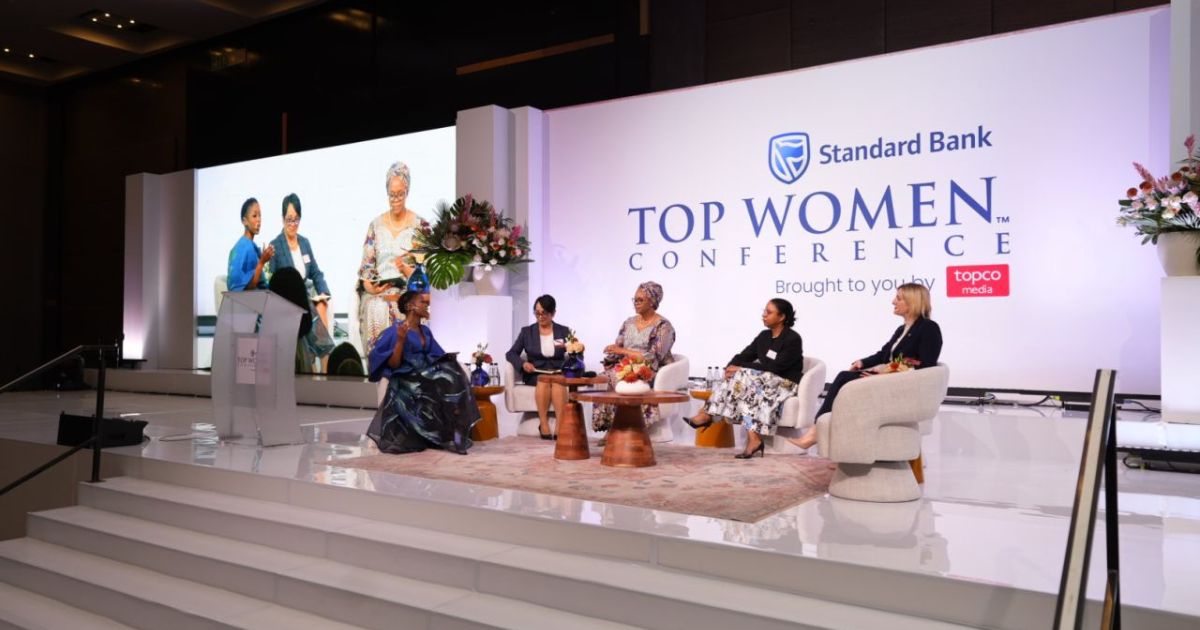
The Standard Bank Top Women Conference returned to the Sandton Convention Centre on 8 and 9 September 2026, bringing together business leaders, entrepreneurs, policymakers and professionals for conversations about women’s role in Africa’s economic future.
Held under the theme “Her Power. Africa’s Future. Amplifying Women-Led Growth,” the Standard Bank Top Women Conference focused on what needs to happen for women to move beyond representation and participate more meaningfully in business, leadership and economic growth.
Discussions covered entrepreneurship, access to funding, networks, education, technology and leadership. One of the strongest messages to emerge was that women do not lack ambition, ideas or ability. The challenge is creating systems that give them access to the opportunities, resources and relationships they need to grow.
For entrepreneurs, the conference also offered practical lessons on funding, building stronger networks and positioning a business for future opportunities.
Women’s Economic Participation Can Unlock Growth
Simone Cooper, Head of Business and Commercial Banking at Standard Bank South Africa, described the current period as a defining moment for Africa.
“Africa’s future is not decades away – it is already here,” Cooper said. She pointed to research commissioned by the Mastercard Foundation, which estimates that increasing the economic participation of young women could unlock up to US$287 billion in additional GDP and create 23 million jobs across Africa by 2030.
For Cooper, this shows why women’s empowerment cannot only be treated as a social issue. “Investing in women is not simply a matter of inclusion; it is not only the right thing to do, but it is also one of the smartest economic choices a continent can make,” she said.
This is especially relevant to the SME sector. Women-owned businesses contribute to employment, innovation and economic activity, but their ability to scale often depends on access to finance, markets, technology and business networks.
Women Need Better Systems, Not More Barriers
Cooper also challenged the idea that women should continuously have to rely on resilience to succeed.
“Success should not depend on how many barriers women can break through. It should depend on how effectively we remove those barriers in the first place,” she said.
This is particularly important for entrepreneurs.
A business owner may have a viable idea and the skills to execute it but still struggle if funding, procurement opportunities or business support systems are difficult to access.
Cooper argued that the focus should therefore move beyond celebrating a small number of women who manage to overcome these barriers.
“Our ambition cannot simply be to produce a few extraordinary women. Our ambition must be to create extraordinary systems that enable millions of women to succeed,” she said.
For financial institutions, corporates and government, this means looking at whether existing systems genuinely create opportunities for women-owned businesses to participate and grow.
Your Network Can Become a Business Asset
Networking was another recurring theme at the conference. Ralf Fletcher, CEO of Topco Media, reminded delegates that influence does not always come from money, seniority or having a powerful title.
“Your power today can simply be, ‘I know someone’, and sometimes that’s enough,” Fletcher said. For SME owners, this is an important reminder that relationships can create access.
A strong network can lead to introductions to potential clients, funders, suppliers, business partners or people who have valuable industry knowledge. Nonkululeko Dlamini, the Chief Financial Officer at Telkom Group, encouraged women to think about what already exists within their networks and which opportunities could come from those relationships.
The lesson for entrepreneurs is that networking should go beyond collecting contact details. The value of a network lies in whether those relationships can lead to useful information, referrals, partnerships and commercial opportunities.
Women Need Sponsors, Not Only Mentors
Cooper expanded on the role of networks by highlighting the difference between mentorship and sponsorship. Mentors can offer advice, knowledge and guidance. Sponsors, however, use their own influence to create opportunities for someone else.
“They advocate for others when decisions are made. They connect people to networks. They create pathways where none previously existed,” Cooper said.
She also reflected on how sponsorship had influenced her own career.
“Some of the most significant moments in my career came because someone was willing to advocate for me when I was not in the room, create an opportunity for me to grow, or back my potential before I fully saw it myself,” she said.
For an entrepreneur, sponsorship could mean an established business leader recommending a smaller supplier for a contract, introducing a founder to a potential funder or connecting someone to a corporate decision-maker.
It shows why business relationships should not only be about receiving advice. The right relationship can also create access.
Investing in Girls Cannot Be Delayed
The conference also connected women’s future economic participation to the opportunities available to girls earlier in life. Dr Nomusa Dube-Ncube graced the stage and stressed the importance of investing in girls and strengthening their pathways into leadership.
“We cannot afford to delay investing in girls,” she said.
Her message highlighted that women’s economic empowerment cannot begin only when someone reaches the workplace, enters leadership or starts a business. Education, skills development and exposure to opportunity all help shape the women who eventually become entrepreneurs, professionals and business leaders.
Early investment can therefore strengthen the pipeline of women entering the economy and ensure that more girls are equipped to take advantage of future opportunities.
Women Still Face Barriers to Influence
Dr Naledi Pandor delivered the keynote address, where she reflected on the progress women have made while acknowledging that barriers remain.
She expressed strong faith in women leaders and spoke about women’s progress in areas such as business and financial leadership. However, she placed an emphasis on women taking ownership of their femininity and stressed that women should not have to mimic men to compete in positions of leadership.
Women still face challenges accessing positions of influence, including within government and other major institutions. This points to an important difference between participation and power. Women can be present in an organisation or economy without necessarily having significant influence over decisions, budgets or commercial opportunities.
For entrepreneurs, economic influence can mean owning sustainable businesses, employing people, winning contracts, accessing larger markets and being included in spaces where important business decisions are made.
Funding Pathways Need to Be Clearer
Access to finance also remained an important part of the conversation. A question raised during the event was whether funders have created strong enough pathways for women to access available opportunities.
The challenge is not always that funding does not exist. Entrepreneurs can struggle because they do not know which funding option suits their business, what the requirements are, or how to position their application.
This creates a gap between knowing that funding opportunities are available and accessing them successfully.
Business owners need clearer pathways and support, but entrepreneurs also need to understand what funders require. A strong funding case usually needs a clear business model, financial discipline, evidence of demand and a clear explanation of how the funding will support growth.
Women Must Help Shape the AI Economy
Technology and artificial intelligence also formed part of Cooper’s vision for Africa’s future. AI is already changing how businesses operate and how industries are structured. Cooper argued that women must actively shape that future.
“Women must not simply participate in the AI economy. They must help build it, design it, lead it and govern it,” she said.
For SMEs, technology can make it easier to automate tasks, market products, understand customers and reach wider audiences. However, access to technology needs to be supported by skills and resources. If women are excluded from developing and adopting emerging technologies, existing economic gaps could become wider.
From Representation to Economic Influence
The Standard Bank Top Women Conference 2026 showed that the conversation about women in business is increasingly moving beyond representation. The focus is shifting towards economic influence.
That means creating stronger networks, clearer funding pathways, better systems, investment in girls and greater participation by women in technology and leadership.
As Cooper said, “The future of Africa will not be determined by what women are capable of achieving. That capability is already evident all around us.”
The bigger challenge is creating the systems and opportunities that allow more women to turn that capability into sustainable economic growth.
For entrepreneurs, the lesson is practical: build a strong business, understand the value you bring, strengthen your network and position yourself for opportunities when they arise.